Japn Travel Agency

Rakuten Travel, Inc.

Monday, February 28, 2011

Banya


Hamanaka settled in the town from the Edo period Yoiti is fishing Hukuwara building was owned by a group of houses had been fishing for herring Hukuhara.

Tsukamemasu whether any had been placed in the building had been used in herring fishing and exploring the spacious grounds.


Banya is a main house accommodation space migrant fishermen, fishermen's wooden floor chamber has become known as Daidokoro(kitchen) two floors, has become in three dimensions to accommodate fishermen.
Also, during the height of the herring fishery off the floor now eating instant meals can be left shoes.

Rice granary

The warehouse had kept the U.S. soybean food products and straw packed between the inner and outer stones, prepared for invasion of rats.


In addition, the warehouse network were housed and nets used in fishing and warehouse documents were stored clothing and important documents stored in the same shape and then place the product being dried Shirako Kazunoko taken from herring and can be crowded at times to know the fishing herring fishery management.


[Activity] in the material culture of each facility in the town museum, except Saturday and Sunday Yoiti is from May to November, with a brief overview of each facility in their holiday volunteer docent.

Sunday, February 27, 2011

Sapporo Clock Tower


The development of Sapporo as the capital of Hokkaido began in 1869, with the help of many foreign experts, engineers and educators. "The Clock Tower" was built in 1878 and is therefore regarded as both a historical and cultural symbol of Sapporo. The Clock Tower was originally called "Embujo" - meaning a 'military drill hall' - and served as a drill hall for the Sapporo Agricultural College (currently Hokkaido University), which was the first institution for Agricultural Studies in Japan.
Dr. William S. Clark, President of Massachusetts Agricultural College, was invited as the first vice-president of the Sapporo Agricultural College. During his tenure, he designed the curriculum with military training, similar to that of MAC. Professor William Wheeler took over after Dr. Clark and planned to build a military drill hall, which was later called the Clock Tower. It is said that Governor Kiyotaka Kuroda of the Hokkaido Development Commission proposed renovating the tower by installing a large clock, which was manufactured and purchased from the E. Howard Watch & Clock Co. of Boston, Massachusetts. The construction of this new addition was completed in 1881.
The simple and practical features of the Clock Tower's wooden structure are typical of American houses found in the Mid-west and West during its colonization. Rooms on the first floor were used as laboratories, lecture rooms, and exhibition space for zoological, botanical, and mineralogical specimens. The second floor was used for physical education training as well as a ceremony hall.
The Clock Tower was designated as a National Important Cultural Property in 1970 and is now a museum that is also used for various cultural activities. The Clock Tower continues to serve as a historical landmark, telling stories of early days in Sapporo.

Sapporo Clock Tower official page


Sakura


Cherry flowers  says Sakura in Japanese.
 
The cherry flowers are probably the most popular in Japan.


 When Spring Comes, and then made a party under the cherry trees and cherry blossoms in.

The Sapporo Beer Garden

 Sapporo Beer Garden


The Sapporo Beer Garden is the only place where you can taste all of Hokkaido's greatest foods at one location.

 Built in the year 23 of the Meiji era, it served as a government office building when the government was sending pioneers to Hokkaido. This profound historical building has an atmosphere that will give you an unique feeling every time you set foot inside.

A giant kessel(or cauldron) from the Taisho period reaches toward the high ceiling of the beer hall where you can eat barbequed mutton on hot plates shaped like Hokkaido, and drink down the delicious draft beer.

Many of our guests who have visited and dined here have exclaimed; " Huge! It is a huge beer hall!", " The ceiling is really high!"" This space is great!".

Friday, February 25, 2011

Carrying a portable shrine

Carrying a portable shrine
They are carrying a Mikoshi through the town.  Mikoshi is a portable shrine.

Dressed much like the festival I also carry a portable shrine.

There are many  booths at the Matsuri festival, selling souvenirs and food !

It's not the same as an American costume party.


Tuesday, February 22, 2011

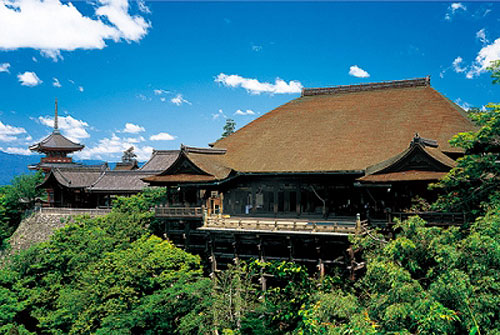
Kiyomizudera Temple

Kiyomizudera Temple


Since many people visit the Heian period as Kiyomizu Kannon.

Tsumeru and climb the approach of the Higashiyama "Otowasan" against the Nioumon, West Gate Tower, Mie (important cultural asset for both) is welcoming.

Spring cherry blossoms and young green, overhanging cliff temple-building in the background and the beauty of fall foliage seasons (National Treasure) is on top of the cliff Seridashi, great views of the city. 15 buildings together (important cultural asset for both) is situated line arranged.
Kiyomizudera Temple is one of the most celebrated temples of Japan.


Japanese most popular hotel booking site


Monday, February 21, 2011

Exclusive Gardens of Kyoto


Exclusive Gardens of Kyoto

Japanese gardens provide tranquility and peace of mind. Through beautiful high-definition images, Exclusive Gardens of Kyoto introduces their historical and cultural background and design philosophy.